Category Archives: United States

Everything is Illuminated

EisIEverything is Illuminated (2005) is a superb film that “begins in goofiness and ends in silence and memory”  (Roger Ebert).  It begins with broad comedy, but zigzags steadily towards a wrenching drama about the connectedness of all humanity and the inescapability of the past.  It’s the tale of a man (Elijah Wood) who goes in search of his grandfather’s escape from the Holocaust, and the story of the people who help him find the story, who are mysteriously entangled in the same story.  All of these people are odd, and they regard each other with astonishment.

Everything is Illuminated is based on the book of the same name by Jonathan Safran Foer (who has a cameo in the film — watch for the man with the leaf blower) and adapted for the screen by Liev Schreiber.  Schreiber also directed the film.   It won awards at a number of film festivals in Europe and South America, but some reviewers felt it did not have the scope of the novel.

The film includes some wonderful performances, particularly that of Eugene Hutz, a Romani (gypsy) musician and actor.  His band, Gogol Bordello, performs several pieces on the soundtrack of the film.  Elijah Wood, a name much more familiar to filmgoers, performs a remarkable act of tzimtzum [contraction]  in taking both a literal and a figurative backseat to the colorful character played by Hutz.

Besides the obvious Holocaust theme, the movie also takes a sharp look at Jewish identity:  what does it meant to be a Jew?

Commentary

Most Holocaust films focus on the tragedy in the 1940’s, without looking at the many tragedies that stem from those initial events.  This is a film that takes a hard look at the way that every person touched by the Holocaust is effected by it, even if he or she is born years later.  It asks questions about survival:  what does it mean, “to survive”?  Can a person live through something and not survive it?  Can a person die but somehow remain?

Two figures in the film are “collectors.”  The film does not explain why they collect things:  that is left for the viewer to consider.  What do each of them collect?  Why do you think they collect them?  Do you think they will continue to collect things, after the events in the film?

I was struck by the subtle reference to the Wizard of Oz at the end of the film.  Jonathan returns to the states, but as he moves through the modern airport, he recognizes faces that he saw in the Ukraine.  What does this mean?  Unlike Dorothy, he was not dreaming.  How are these people connected to the people he saw overseas?  How is he connected to each of them?

Jewish culture puts a high value on Zikkaron, Remembrance.  Who is remembering what in this film?  What is the value of remembrance?

Double Feature

The screenwriter and director of this film, Liev Schreiber, is an actor in another film on this list, Defiance.  Both are films about events connected with the Holocaust, but they deal with it quite differently.

Other Reviews

For a slightly different take on the film, check out this blog post.

Crossing Delancey

AFA 195259Crossing Delancey (1988) is a romantic comedy about a woman in her early 30’s whose Bubbe thinks she should be married already.  Amy Irving plays Izzy Grossman, who has a fancy job Uptown in Manhattan, and whom Bubbe’s matchmaker friend has matched with Sam Posner, a blue-collar fellow who sells pickles on the Lower East Side played by Peter Riegert.   The tension in the plot is between tradition and modernity, and there is never much doubt which will triumph.

One notable performance in the film is that of Reizl Bozyk, who plays Bubbe.  She was one of the stalwarts of Yiddish theater, first in Poland and then in New York, but this is her only performance in American film.

Commentary

Crossing Delancey is billed as a romantic comedy, but the most vivid relationship in the film is that between Izzy and her grandmother.  Izzy is a modern woman, circa 1988, but she also cares deeply for her Bubbe, visiting her regularly in the old neighborhood, and looking after her.  She is exasperated but respectful when Bubbe hires a matchmaker, agreeing to meet “the match” only to humor Bubbe.

Izzy’s relationships with her friends receive almost as much time as the romantic relationships in the film.  Izzy’s work world is fully assimilated into secular American life (in this case, that of the New York intelligentsia), but her family and friendships are deeply rooted in Jewish culture and society.  She and her friends alarm their mothers, straying far into the modern world of work and career, but the film suggests that at heart, Izzy’s heart is still on the Lower East Side.

This is one of the rare films that shows Jewish women and their relationships in a warm and realistic light.  All of the women in the film could have been written and played as stereotypes, but fortunately for us, the writer and the director chose otherwise.

Double Feature

Watch Kissing Jessica Stein for a version of a similar romantic comedy made thirteen years later.  Another mother is anxious for her daughter to “find someone,” but a lot changed in those thirteen years.  What the two films have in common is a warm depiction of Jewish grandmothers, mothers, and daughters who love one another deeply, and who are people you might wish you knew.

Amy Irving co-starred in another film about a Jewish woman made in the 1980’s, Yentl.  There she played Hadass, the conventional, traditional foil to Yentl’s choices about gender.

Questions

Roger Ebert argued in his review of this film that Izzy and Sam characters are so constrained by the conventions of American romantic comedy that they are barely more than “plot devices”:  stock characters given stock speeches.   Whether Izzy is a “real” character or a “plot device” what do you think of her choices and behavior?  Do you know anyone like Izzy, or is she a caricature?

Kissing Jessica Stein

kissing-jessica-stein-10000648Kissing Jessica Stein (2001) is a  romantic comedy about two women who, for different reasons, decide to try dating women instead of men.  Jessica Stein (played by Jennifer Westfeldt) is 28 and a nervous perfectionist, and she is feeling desperate about finding “the One.”   Helen Cooper (Heather Juergensen) is a free spirit who decides to place a personals ad, and throws in a Rilke quotation on the advice of a gay male friend.  Jessica sees the quotation, and despite her unease at the idea of dating a woman, decides this is a possible soulmate. On this shaky beginning builds a relationship — and a film — that investigates the risk/reward ratios of love and life.

Tovah Feldshuh gives a standout performance as Jessica’s mother, a role which initially embodies the “Jewish mother” stereotype but gradually reveals a heart and soul that may make viewers wish for a mother like her.    Many of the characters in the film develop along similar lines:  we think we know them, and then we get to know them a little better.  In the case of the Jessica’s generation, they get to know themselves better.  It’s a fine screenplay, and in an interesting turn of art and life, it was written by the two women who play the leads, Westfeldt and Juergenson.

Kissing Jessica Stein won awards from major film festivals and was well-received by critics.

Commentary

So, you are wondering, why is this film on the “Jewish Film” list at all?  Jessica is a Jew.  Her family is a Jewish family, and the picture we get of them is much more real and warm than the caricature we usually see in American films.  We see this Jewish family in many of the places where families gather:  at High Holy Day services, at Shabbat dinner, at a family wedding.

The depiction of her mother is strikingly different from the stock character that is usually trotted out by filmmakers and comics:  one cannot help but notice that this film was written by women, not by men.   She is anxious for her daughter to marry, and is constantly setting up ambushes with men she thinks are eligible, but she is a wise woman who genuinely loves her daughter, and who knows a thing or two about love.

Jessica Stein is a Jew and Helen Cooper is not.  Once Jessica’s family becomes aware of Helen, they try very hard to be welcoming of this lesbian (!) non-Jew (!) and they make most of the usual missteps, on both counts.  Their goodwill is obvious, though, and the small scenes in which Helen tries to fit in and they try to make a place for her would make an interesting jumping-off spot for discussion.  While the interfaith angle is not a major focus of the film, everything in the film about it is quite good.

That said, Kissing Jessica Stein avoids a serious discussion that it could have had (but then, it wouldn’t be a comedy.)  Helen  is looking more for interesting sex than for love.  Jessica is looking for someone “perfect,” and the subject of love doesn’t seem to have occurred to her.  Neither woman is really looking for love, and when they stumble into it, they… stumble.  What truly went wrong here, and was it really only the most obvious thing?

Keeping the Faith

ktfposterm“Have you heard the one about the priest and the rabbi…?” We’ve all heard those jokes. Keeping the Faith (2000) tells the story of a priest and a rabbi and the girl that both of them wanted. It was directed by Edward Norton, who also plays the priest.  Ben Stiller plays the rabbi, and Jenna Elfman, the girl.  The priest and the rabbi are both hip young clergy who play basketball together regularly, and when they fall for the same girl, romantic comedy ensues.
Commentary

I am going to level with you up front:  I included this film because it was popular and a lot of people saw it and continue to mention it.   I think it is a bad film, a destructive film, because it deals in nasty stereotypes and bad information all wrapped up in a feel-good ribbon.

I could forgive Keeping the Faith for being a less-than-perfect romantic comedy:  it’s predictable, over-long, and cutesy, but it tackles an interesting subject, interfaith relationships, both friendships and dating.  What I find unforgivable in this film makes a long, depressing list, especially since the film often appeals to people who haven’t spent much time lately around either priests or rabbis.  To wit:

1.  The stereotypes of Jewish women in this film are poisonous.  They are portrayed either as greedy, nagging mothers or as greedy, materialistic harpies.  One such woman I might find amusing in the right context, but a film that suggests that ALL born Jewish women are like that is a nasty bit of misogynist anti-Semitism.

2.  I don’t know any congregational clergy with the free time enjoyed and abused by the priest and the rabbi in this film.

3.  Jake (the rabbi) doesn’t see this woman as marriage material, but he has an affair with her, lying about it to everyone including his best friend.  Then, in an act of utter narcissism, he decides that his Yom Kippur sermon is the time to come clean about the fact that he’s been doing this. Ethics, anyone?

4.  I’ll refrain from criticizing the priest (he’s not my department) but he doesn’t come off much better.  Neither clergyman seems to believe in anything with much conviction.  They are cardboard cutouts, moving slowly through a really bad priest-and-rabbi joke.

5.  As Andrew O’Hehir puts it perfectly in his review in salon.com:  “The two religions are treated with a benign stupidity that is supposed to signal respect, as if they were adjacent departments in the spirituality mall that sold slightly different brands of the same product and made no serious demands on their adherents.”  It’s a witless, gutless approach to talking about interfaith issues: “There are no important differences.”

If you want to see a movie that goes much deeper into the territory of interfaith relationships, and is funnier to boot, try Annie Hall.  Woody Allen’s secular Jew and Diane Keaton’s nice lukewarm Methodist provide a much more interesting meditation on the attraction and the challenges of difference.


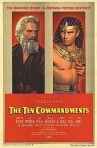
The Ten Commandments

200px-10Command56The Ten Commandments (1956) was the last film that Cecil B. DeMille directed.  It is the most famous of the “Bible epic” genre, telling the story of Moses (played by Charlton Heston)  and the deliverance of the Hebrew people from slavery in Egypt under Pharoah.

The film was actually a remake of a 1923 film, The Ten Commandments, also directed by Mr. Demille.  Both films feature the heroic style of acting favored in silent films.  The 1956 film was notable for its “cast of thousands,” for the location shots (parts of it were filmed in Egypt and the Sinai) and for its use of special effects, particularly the parting of the Red Sea.

The screenplay differs significantly from the account in Exodus, making use of various midrashic sources, the Qur’an, Josephus, and elsewhere. The film continues to be enormously popular, and has been parodied many times.

Commentary

“…and he looked just like Charlton Heston!” is the punchline of many a joke told by many a rabbi to liven up a sermon.  Despite the fact that the screenplay makes Hollywood chopped liver of the story in Exodus, this is another of the films that qualifies as a “must see,”  because it is a key part of popular Jewish culture.

Just be sure to actually READ Exodus sometime.  Also, take a look at the story of deliverance as told in the traditional Passover Haggadah.

Questions

If you were going to make a film about the deliverance from Egypt, would you use the screenplay of this movie, or the screenplay of  1998 animated film The Prince of Egypt, or the story in the Haggadah, or the story as told in the biblical book of Exodus?  If you were going to use elements of each, which would you choose, and why?

Biloxi Blues

biloxi_bluesBiloxi Blues (1988) is the second play in Neil Simon‘s semi-autobiographical “Eugene” trilogy, directed by Mike Nichols and starring Matthew Broderick, who originated the role on Broadway.   Most of the story is set in the barracks of an army base in Biloxi, MS, in 1945, where 20 year old Eugene Jerome struggles with heat, mosquitoes, virginity, and an eccentric drill instructor (played by Christopher Walken) .  As one of only two Jews in the barracks, he has to cope with the anti-Semitism of the sergeant and the other recruits, and with the general sense that he has somehow landed on an alien planet a long, long way from Brooklyn.  His best friend is the other Jew, Arnold Epstein, played by Corey Parker.

Commentary

Biloxi Blues is first and foremost a young man’s coming-of-age story, and as such, it follows the conventions, and accomplishes that in fairly conventional ways.  One more interesting aspect of the film, though, is the way that two young actors, Broderick and Parker, portray the two Jews in the company.   Some of the roles are clear in the screenplay, but the choices made by the actors and the director pose us a fascinating question:  when one is a Jew, a new Army recruit deep in the bowels of the South, surrounded by mostly unfriendly anti-Semites, what is one to do about that fact?

Eugene experiments with various approaches:  he wisecracks for a while, until it is clear that it will win him no friends.  Gradually he attempts to blend in:  he doesn’t hide his Jewishness, but he wears it lightly, shrugging off slurs, and laughing with the other guys when he can.  He’s a lousy soldier, but he tries hard to fit in.

Arnold chooses another route:  he is not concerned with popularity.  He is in fact determined not to fit in, because he does not approve of most of what he sees around him.  At one key moment, when asked why he is so pointed about his Jewishness and his insistence on his own values, he says, “The Army has its logic.  I have mine.”  He is utterly uncompromising about his values, and it costs him dearly.

The two Jews drive one another to distraction:  from Eugene’s point of view, Arnold makes everything unnecessarily hard for himself.  He admires Arnold’s “constant and relentless pursuit of truth, logic, and reason,” but it interferes with his own efforts to keep his head down and get along.

From Arnold’s point of view, Eugene seems to stand for nothing at all.  Eugene’s real coming-of-age doesn’t happen among the usual trappings and conventions:  it isn’t his first sexual experience, or his first experience of love, it’s his discovery that there is something in his life worth dying for.  I won’t spoil the film by saying more.

Questions

How do you decide when to stand up for your beliefs, and when to duck the question?  Has anyone ever made an anti-Semitic joke when you were in earshot?  What did you say or do?  How about a racist joke, or a homophobic joke?  Where is the line (is there a line?) between “political correctness” and standing up for your values?
Double Feature

Biloxi Blues makes an interesting companion piece to Gentlemen’s Agreement.  They portray the same period, although Biloxi Blues does so with forty years’ hindsight.  Gentleman’s Agreement shows the workings of anti-Semitism in genteel New York society; Biloxi Blues shows it in the coarse melting-pot of an Army boot camp.  What are the differences, if any?

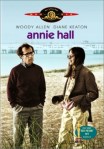
Annie Hall

annie-hall1Annie Hall (1977)  was advertised in its trailer as “A Nervous Romance.”  It records the romance of Alvy Singer and Annie Hall, two characters based on the real lives and personalities of the actors who play them, Woody Allen and Diane Keaton.  Singer is a Jew from Brooklyn, Annie is a gentile from the Midwest, and while we know from the first frames of the film that this is a romance that will not last, it maintains interest by way of its intelligent characters.

Much has been written about why this movie is one of the great American films:  for a standard review by a critic who appreciates it, take a look at Roger Ebert’s 2002 essay on the film.

Questions

Looking at Annie Hall specifically as a Jewish film, it is interesting to watch for the interfaith tensions in Alvy and Annie’s relationship.  In an early scene with a friend, Alvy talks about his antennae for anti-Semitism:  he has a tendency to see it everywhere, and it frightens and worries him.  Annie states flatly during an early date, that her Grammy doesn’t like Jews, and we see him pause for a moment and digest this information; in the heat of this new relationship, he allows it to pass.  But the issue surfaces again when he meets the family at Easter lunch.

Annie has her own difficulties, as Alvy embarks on a campaign to improve her (ironically, to make her more like his Jewish ex-wives.)   This film, however, is from Alvy’s point of view:  we don’t know exactly how Annie feels about the differences between them, for instance when he flinches as she orders pastrami on white bread with mayo.  We see what she does, but except in a one scene (when they are first falling in love) we do not have the benefit of hearing her inner voice.

Do you think that Annie Hall offers an accurate picture of the challenges that a couple face when they meet across cultural differences?  If so, was the relationship really doomed, or could it have been salvaged?  How?

If it isn’t an accurate  picture of the challenges in an interfaith relationship, where does it go wrong?  How is it a false picture?

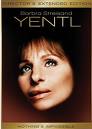
Yentl

1yentlYentl (1983) is the film adaptation of the short story, “Yentl, the Yeshiva Boy” by Isaac Bashevis Singer.  It is set in a Polish shtetl in 1907, where Rabbi Mendel, a widower, is secretly giving his daughter Yentl the sort of Talmudic education that only boys were allowed to have.  Yentl has a passion for Torah, and when her father dies, she disguises herself as a boy and travels to the yeshiva in the nearest town to study.  Barbra Streisand co-wrote, co-produced, directed and starred in Yentl; work on the film re-energized her own interest in Jewish study.

It is thus far the only major motion picture that focuses on a Jewish woman living a specifically Jewish life, and raises questions about the limitations of gender roles in traditional Jewish communal life.  Yentl is contrasted in the film with Hadass, (played by Amy Irving) who conforms to the social ideal for young women, and with the men who take their life in the yeshiva for granted.   Streisand made no secret of her own personal identification with Yentl.  Just as Yentl strove to succeed in the “man’s world” of the yeshiva, Streisand saw herself striving for success in the “man’s world” of the Hollywood film industry.

Commentary

Singer hated Streisand’s treatment of his short story.   He felt that it had been over-expanded into a star vehicle, with unsuitable music and a ridiculous ending.  Certainly that is one valid point of view on the film.

However, Streisand has perfectly conveyed the passion for Torah that is at the center of the scholar’s life, that fueled so much of the development of Jewish tradition and sacred literature.  She conveys the frustration that women have felt and still feel when they are excluded from access to the highest levels of study.  While many of Singer’s complaints are valid,  her command of the Jewish details of Yentl’s life is impressive.

Double Feature

Yentl makes an interesting companion to the other big Jewish musical, Fiddler on the Roof.  They are set in the same period, they begin in the same sort of place (a tiny shtetl in the Pale of Settlement) but they depict different classes in Jewish society.  Where Tevya and his daughters are peasants, Yentl is the rabbi’s daughter and Hadass is a city girl, daughter of a wealthy Jewish merchant.  How are the women’s lives similar?  How are they different?  Do you notice any other interesting similarities or contrasts between the two films?

Defiance

defianceDefiance (2008) tells the story of the four Bielski Brothers, Tuvia, Zus, Asael, and Aron, who gathered and led a 1200-member community of Jewish resistors in the forests of Belarus during the Holocaust, preserving their lives. The film was directed by Edward Zwick, and stars Daniel Craig and Liev Schriber.    It opened to mixed reviews and some controversy:  reviewers tended to credit Zwick with a high degree of historical accuracy, and some controversy.

Polish commentators argue that while the film acknowledges that the Bielskis allied their group with Soviet partisans in the area, it fails to reveal the significance of that alliance:  this was not the regular Soviet Army, but an NKVD group (NKVD being the precursors to the KGB.)  The Soviet Union had NKVD operatives in the area to murder Poles in preparation for a Soviet invasion.

While the film doesn’t engage with this particular controversy, it makes no bones about the fact that often the group had to operate in ethically questionable ways.  The Bielski brothers managed to save over 1000 Jewish lives.  Whether that outweighs their methods and choices is a question worth discussion.

Commentary

As history, Defiance is a success; it tells the story without significantly changing it.  However, as a drama it received mixed reviews.

Reviewer Mick LaSalle of the San Francisco Chronicle points out that this is a problem of the “Holocaust genre” as it has developed in American film.  According to LaSalle, successful “Holocaust drama” has good guys (Jews, or a Christian trying to save Jews) bad guys (Nazis or collaborators), and ultimately an upbeat ending in which the good guys survive to tell the tale.  Given that we are talking about the Holocaust, the “upbeat ending” requirement is more than a little ridiculous.

The good guys of Defiance are the Bielskis, who steal and kill in the interest of preserving the group.  At least one of them is more interested in revenge than survival.  The way the film is cut, the main conflict in the film is not Jews-vs-Nazis or even Jews-vs-Death, but brother-vs-brother as Tuvia and Zus wrestle over the question of revenge versus community organizing.  Given the backdrop of survival in the forest with Nazis circling behind every rock and tree, there is a feeling of disconnect through the film:  why are these guys fighting?  Don’t they realize who the real enemy is?

Still, Defiance is well worth watching because it is an accurate account of one of the cases in the Holocaust where Jews fought back and did so successfully.  The fact that the filmmaker chose fidelity to history is really rather remarkable, given that, as LaSalle pointed out, were the film to fit the genre, the Bielskis would have been re-visioned to paint them as saints.  They weren’t saints; they were human beings in an inhuman situation.  Their choices, and our discussion of their choices, can make for genuine learning.

Questions:

What choices did the Bielskis make in order to survive?  What options did they refuse to take?  Could you say that their choices were informed by Jewish values?  Why or why not?

What other Holocaust films have you seen?  Did they fit Mick LaSalle’s description of the genre?  Given that many Americans get most of their Holocaust education from the movies, what consequences do you see for the “happy ending” requirement?  What are the consequences of changing the details of stories so that the Jews make no ethically questionable choices, and appear “saintly”?

Crimes and Misdemeanors

Crimes and Misdemeanors (1989) is one of Woody Allen‘s best films, a thriller in which, as the film critic Roger Ebert wrote, the suspense is not about what will happen to people, but what decisions they will make.  The film consists of two stories, which meet only at the end.  In the first, a drama, a successful opthalmologist played by Martin Landau lives a charmed life:  he has financial success, a beautiful family, a happy marriage, and the esteem of his community.   He chooses to have an affair with a flight attendant, (Anjelica Huston) and when he decides to break off the affair, she becomes furious, threatening every good thing in his life.  He seeks advice about what to do:  from a patient who is a rabbi, and from his brother, a ne’er-do-well with Mob connections.  Each offers him his best suggestion, but the doctor has to choose.    In a parallel story, a comedy, a documentary filmmaker accepts a job making a film about his brother-in-law, a successful Hollywood producer (Alan Alda), in order to raise money for a film he is making about a philosopher.  The filmmaker is in a failing marriage, and he becomes infatuated with the associate producer, played by Mia Farrow.  He chooses to try to initiate an affair with her.

All the decisions of all the characters are played out by the end of the film.  We are left to consider the nature of good and of evil, of faith and skepticism, of love and hate.

Commentary

(NOTE:  there are spoilers in the commentary and questions.  Stop here if you do not want to know what choices the men make.) If I were to interview Woody Allen myself, there is one question I would love to ask him:  Did he write Crimes and Misdemeanors with Psalm 94 consciously in mind?  The question in this film is precisely that of the Psalmist when he asks, in Psalms 94:3 “How long will the wicked, Adonai, how long will the wicked be jubilant?”  I might be inclined to say no, this is just the eternal cry against the unjustness of life, except for verse 7, which says: “They say, ‘Adonai does not see; the God of Jacob pays no heed.'”  Again and again in the movie, the murdering opthalmologist quotes his father, who said, “God sees everything.”  And yet, by the end of the film, despite that, nothing bad has happened to the murderer.  Apparently there there will be no divine retribution for the sin of killing an inconvenient lover.

Allen’s vision of the world is utterly bleak.  He sees the bad guys getting away with their crimes, and the better man getting nothing.  However, the better man isn’t without his own sins:  he is simply an ineffectual bad guy.  As for the man of faith, the only truly good man in the film, he goes blind.

Questions

This is a great Jewish film because it engages with serious Jewish questions:  why be righteous?  What is the meaning of law?  Who sees most clearly, the blind rabbi or the guy who insists on “seeing the world as it really is”?  Is faith valuable, or is it merely self-deception?  Does faith make us stronger, or weaker?  What is Woody Allen saying in answer to these questions?  Do you agree or disagree with him?

Many of the characters in the film have an immature approach to faith; they go to childhood memories for their ideas about God.   The two exceptions — adults with mature approaches to faith —  are the philosopher and the rabbi, neither of which is a fully drawn character.  One of them dies a suicide, the other loses his eyesight.   What effect does this have on the discussion of the questions in the film?